

Roland ZettelThe Baron of the Earldom of Wigtoun
Lord of Cumbernauld
The Much Honoured Baron of the Earldom of Wigtoun (Roland Zettel, holder of the dignity of the Earldom of Wigtoun in the baronage of Scotland and Lord Baron of Cumbernauld)
Credentials
- • On the form "Baron of the Earldom": the Roll styles the holder of an earldom in the genus of barony as Baron of the Earldom. The Lyon Court used this form for Annandale in 1983, "Baron of the Barony of the lands of the Earldom of Annandale and Hartfell" (Letters Patent, 4th February 1983), and it follows the older usage recorded by Lord Lyon Innes of Learney: "Where a peer held a feudal barony (as well as his dignities of Baron-Banrent ('Lord')), his feudal Baronies are added to his style in the form 'Baron of the Barony of X——'" (The Robes of the Feudal Baronage of Scotland, Proceedings of the Society of Antiquaries of Scotland, vol. 79 (1944–45), p. 158). The Roll does not use the longer form for a barony, which is recorded simply as "Baron of X", the form upheld in the Esslemont petition of 1934 (same paper, pp. 162–163). It uses it for this earldom because the earldom has no shorter name that is true of its holder: the 2021 patent names the earldom but recognises no earl's style, and the erected barony within the unit bears another name, Cumbernauld, which the holder also carries as Lord Baron of Cumbernauld. Lord Lyon Sellar held that the owner of lands erected into an earldom "has no claim to a style greater than that of baron" (Sturzenegger of Arran, c. 2010). The peerage Earldom of Wigtown is extinct.
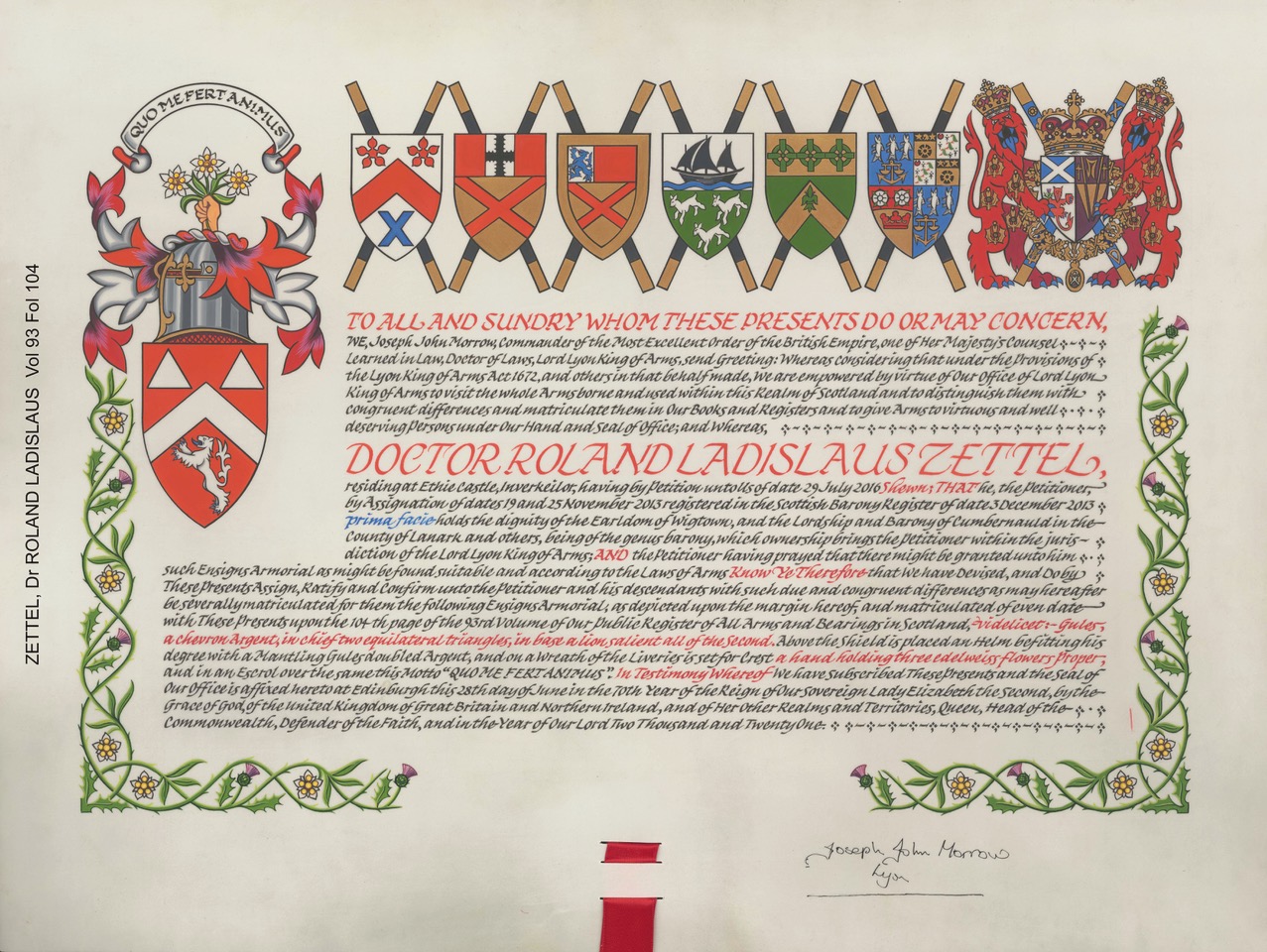
- • Letters Patent of Lord Lyon Morrow, 28th June 2021, Public Register of All Arms and Bearings Vol 93 Folio 104, reciting that by Assignation recorded in the Scottish Barony Register of date 3rd December 2013 the petitioner "prima facie holds the dignity of the Earldom of Wigtown, and the Lordship and Barony of Cumbernauld … being of the genus barony"; petition 29th July 2016. The holder uses the older spelling Wigtoun.
- • The lands were erected into "a lordship and barony, to be called the lordship of Cumbernauld" by Crown charter of 18th January 1588/9; the Earldom of Wigtown was created by patent, 19th March 1606 (The Scots Peerage, vol. VIII, pp. 545–546). No charter erecting the lands as an earldom has been found in the printed register; charters may survive outside it.
- • See the Association's paper: baronage.com/…/non-peerage-earldoms
Authentication
A note on terminology: “Scottish feudal barony” or “feudal title” is an incorrect, defunct historical term for extant barons. Baronies were feudal until 28 November 2004, when feudal baronies were abolished and the dignity of baron was retained — an extant barony is no longer “feudal”. The correct term is Scottish barony or Scottish baron (or baron, lord or earl in the Baronage of Scotland, collectively the minor barons of Scotland); never “feudal baron”. Why the term is defunct →
A barony pledged on the Roll of Scottish Barons is treated by the Roll as hereditary and not in commercio. A pledged barony later conveyed outside the family forfeits its recognition on the Roll in perpetuity. What “Hereditary on the Roll” means →