
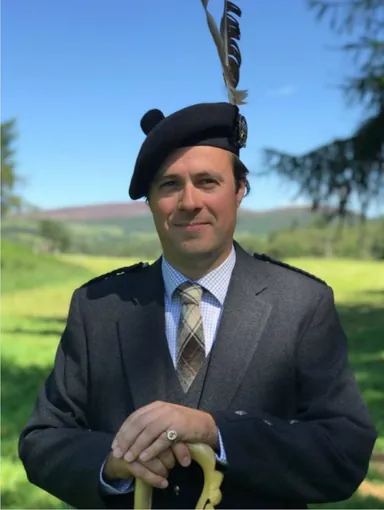
Philip Farquharson of InvercauldThe Baron of Invercauld
Baron of Omnalprie, Chief of the Name
The Much Honoured Baron of Invercauld (Philip Farquharson of Invercauld, 17th Baron of Invercauld and Omnalprie, Chief of Clan Farquharson)
seat Invercauld 95k acres
Credentials
- • Previous-holder-[father?]: Burke’s Peerage, 107ed. Burke's Peerage (Genealogical Books) Ltd, 2003, p. 1395 column 2 "Baron of Invercauld and Omnalprie so recognised by Ld Lyon King of Arms and matric arms at LO 30 Nov 1949"
- • No Lord Lyon Court matriculation or Edinburgh Gazette Roll of the Chiefs entry has been located for Farquharson of Invercauld; classification rests on Burke's Peerage and press sources only
- • facebook.com/…/1233531597835091
- • PLEDGED HEREDITARY TITLE, pledged by the Roll: baronies held across generations are treated by the Roll, for its own purposes, as de facto hereditary. The title becomes unrecognised by the Roll if the barony is later conveyed outside the family, in accordance with Roll policy.
A note on terminology: “Scottish feudal barony” or “feudal title” is an incorrect, defunct historical term for extant barons. Baronies were feudal until 28 November 2004, when feudal baronies were abolished and the dignity of baron was retained — an extant barony is no longer “feudal”. The correct term is Scottish barony or Scottish baron (or baron, lord or earl in the Baronage of Scotland, collectively the minor barons of Scotland); never “feudal baron”. Why the term is defunct →
A barony pledged on the Roll of Scottish Barons is treated by the Roll as hereditary and not in commercio. A pledged barony later conveyed outside the family forfeits its recognition on the Roll in perpetuity. What “Hereditary pledged upon the Roll” means →