
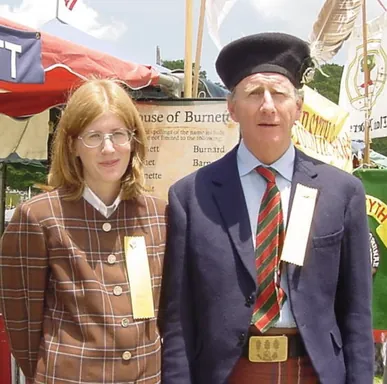
James Burnett of LeysThe Baron of Kilduthie
Chief of Clan Burnett
The Much Honoured Baron of Kilduthie (James Comyn Amherst Burnett of Leys, Baron of Kilduthie, Chief of Clan Burnett)
heir Alexander The Younger of Leys
known as The Baron of Leys-Kilduthie
Credentials
- • Combining baron of TD-barony has precedent from Innes of Learney on the usage of Lord Lyon Innes of Learney. In the Esslemont petition of 1934 the petitioner, Gordon of Hallhead, whose barony was Esslemont, was recorded in the Lyon Register as "Baron of Esslemont" (vol. xxxi, p. 20); Innes, writing as Lord Lyon in 1945, referred to him as "The Baron of Hallhead-Esslemont", who "duly received both chapeau and designation, consistently with the statute and the ancient precedents of Lyon Court" (The Robes of the Feudal Baronage of Scotland, Proceedings of the Society of Antiquaries of Scotland, vol. 79 (1944–45), p. 160 n. 1 and p. 163). The joined form is a social style; the recorded title remains Baron of the barony. The wife of a baron with a territorial designation is known by it: Lady Leys. See baronage.com/proper-address.
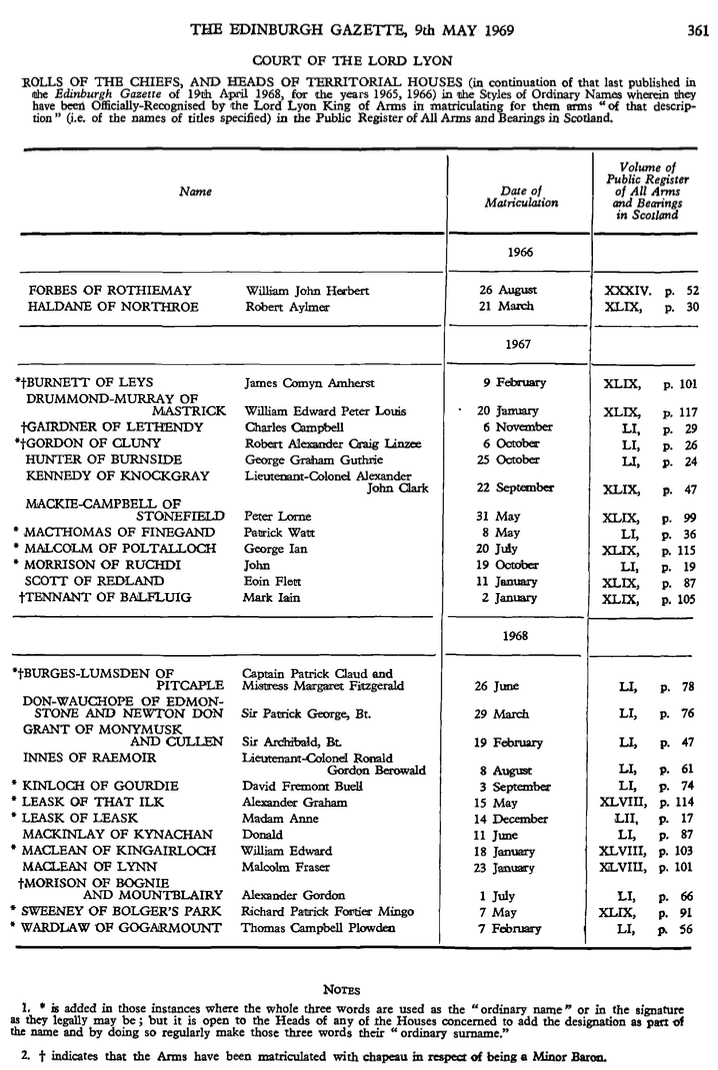
- • Rolls of the Chiefs and Heads of Territorial Houses, Officially-Recognised by Lord Lyon King of Arms 9th Feb 1967 (XLIX 101), EDINBURGH GAZETTE 1969 *†BURNETT OF LEYS — James Comyn Amherst [minor baron mark, of which barony confirmed in burkes]
- • Burke’s Peerage, 107ed. Burke's Peerage (Genealogical Books) Ltd, 2003, p. 262 column 1 "baron of Kilduthie"
- • PLEDGED HEREDITARY TITLE, pledged by the Roll: baronies held across generations are treated by the Roll, for its own purposes, as de facto hereditary. The title becomes unrecognised by the Roll if the barony is later conveyed outside the family, in accordance with Roll policy.
Authentication
A note on terminology: “Scottish feudal barony” or “feudal title” is an incorrect, defunct historical term for extant barons. Baronies were feudal until 28 November 2004, when feudal baronies were abolished and the dignity of baron was retained — an extant barony is no longer “feudal”. The correct term is Scottish barony or Scottish baron (or baron, lord or earl in the Baronage of Scotland, collectively the minor barons of Scotland); never “feudal baron”. Why the term is defunct →
A barony pledged on the Roll of Scottish Barons is treated by the Roll as hereditary and not in commercio. A pledged barony later conveyed outside the family forfeits its recognition on the Roll in perpetuity. What “Hereditary on the Roll” means →