 The Roll of Scottish Barons

 Enrolled
Earl in the Baronage of Scotland
The Much Honoured Earl of Rothes
A heritable dignity, honour and title of nobility in the Baronage of Scotland, entered on the Roll of Scottish Barons.
Earl of Rothes (Dario Item) [Much Hon Earl of Rothes, I&P Law Office SA, Viale Carlo Cattaneo 1, 6900 Lugano, Switzerland] in the baronage of Scotland and Hereditary Sheriff of Fife, also 7th generation Prince of St Rosalie and Duke of Miraglia in the Kingdom of the Two Sicilies (foreign titles, outside the Roll’s scope), addressed as Lord Rothes or My Lord, and known professionally as His Excellency Ambassador Dario Item, Earl of Rothes.
He succeeded in 2024. Born in Naples, Italy 28 June 1972, educated at the Universities of Geneva and Teramo (Dr iuris 1996), the University of Teramo (Dr rerum politicarum 2004), the University of Genoa (Master’s 2005), the University of Ferrara (Master’s 2006), the University of Parma (PhD 2009) and the University of Teramo (LLM 2012).
Family
Spouse Much Hon Andrea, Countess of Rothes, married 16 December 2000
Heir Giulio, Younger of Rothes, born at Lugano, Switzerland 27 January 2013
Issue Four children
Achievements
Ambassador Extraordinary and Plenipotentiary of Antigua and Barbuda to the Kingdom of Spain, the Principality of Monaco and the Principality of Liechtenstein since 2018, and Permanent Representative of Antigua and Barbuda to the United Nations World Tourism Organisation since 2021.
Orders and decorations
- Grand Collar of the Royal Order of the Eagle of Georgia7 November 2023
- Grand Collar of the Order of Merit of the Portuguese Royal House2 January 2022
- Knight Grand Cross of the Imperial Order of Emperor Menelik II16 April 2020
- Knight Grand Cross of the Royal Equestrian and Military Order of Saint Michael of the Wing27 September 2020
- Knight Grand Cross of the Royal Military Order of Our Lady of the Conception of Vila Viçosa8 December 2019
- Great Star of the Royal Order of the Crown of Georgia1 July 2020
- Senator Grand Badge of the Royal Order of Saint Queen Tamar1 July 2020
- Caballero of the Maestranza de Caballería de Castilla1 April 2020
- Caballero of the Orden del Tercio de Extranjeros26 February 2020
- Medal of the Real Cuerpo de la Nobleza del Principado de Asturias14 November 2023
- Medal of the 1300th Anniversary of the Proclamation of King Don Pelayo1 July 2020
- Medal of the Cruz de Distinción del Ejército de Asturias22 June 2020
- Medal of the Regimiento de Infantería Asturias No. 3124 June 2020
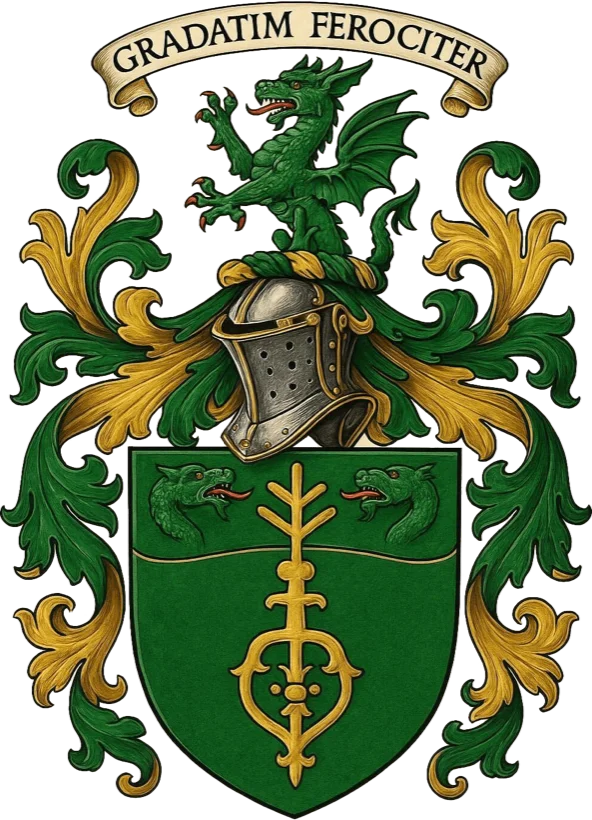
Gradatim FerociterStep by step with determination
Arms
Vert a hauszeichen Or on a chief enarched two dragon’s heads couped combatant Vert.
Crest
A demi-dragon rampant Vert.
Mantling
Vert doubled Or.
Pennon
Two tracts of the liveries Vert and Or, with his arms in the hoist and his motto counterchanged.
Warrant granted by the Lord Lyon King of Arms, 4 April 2025
 Enrolled
 on the Roll of Scottish Barons
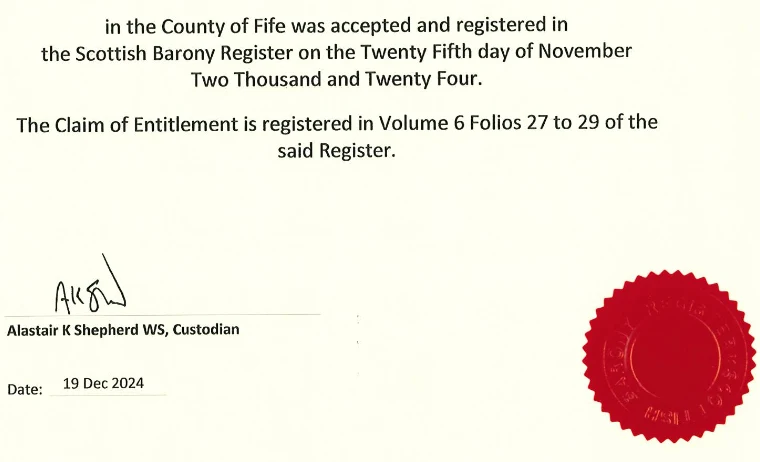
Verified against the certificate of the Scottish Barony Register
- Dignity
- The Earldom of Rothes and the Hereditary Office of Sheriff of Fife, County of Fife
- Claim registered
- Scottish Barony Register, 25 November 2024, vol. 6, folios 27–29
- Certificate
- Signed by the Custodian, 19 December 2024
- Arms warrant
- Granted by the Lord Lyon King of Arms, Edinburgh, 4 April 2025
- Earl’s style
- Officially recognised by Lord Lyon Blair for his predecessor: Warrant of 5 September 2006; Letters Patent matriculated 6 August 2007, Public Register vol. 87, p. 112
- Entry revised
- 25 October 2026
Lineage
The House of Item
The lineage of the Prince of St Rosalie and Duke of Miraglia traces a seven-generation descent through the Item family, rooted in the nobility of the Kingdom of the Two Sicilies.
- Josef Anton Item, married Hanna Elena Holzer (died 1830), and died 1820, from whom
- Jakob Item, born 15 April 1803, married 9 June 1838 Rachele Visconti (born 10 April 1805; died 11 January 1878), and died at Gaeta, Two Sicilies 3 June 1844, from whom
- Vincenzo Carlo Item, born 28 February 1839, married 9 October 1862 Chiara di Martino (born 24 April 1844; died 8 November 1912), and died 13 September 1900, from whom
- Aurelio Item, born 8 February 1871, married 29 October 1899 Giulia Pagano (born 9 May 1879; died August 1951), daughter of Domenico Pagano, and died 26 January 1941, from whom
- Ettore Item, born 14 May 1909, married 27 February 1929 Emilia Palumbo (born 15 August 1912; died 4 February 1999), and died 18 August 1988, from whom
- Giulio Vincenzo Vittorio Item, born 29 March 1931, married at Naples, Italy 13 December 1953 Liliana Galiani (born 17 July 1931), and died at Lugano, Switzerland 12 May 2006, from whom
- The present Earl, see above
The Earldom of Rothes (1886)
The Earldom of Rothes is one of the most historically layered titles in Scotland, bearing both peerage and baronial significance. Originally conferred in 1458 by King James II upon George Leslie, the creation of the Earldom coincided with the Crown’s grant of the territorial Barony of Ballinbreich. At this early stage, the title functioned within the framework of feudal nobility, whereby the dignity was inherently linked to territorial jurisdiction and ownership.
While the peerage dignity was unquestionably recognised by Parliament, the first recorded Crown Charter for the Earldom’s baronial structure appears somewhat later, in a 1547 entry in the Register of the Great Seal of Scotland. This entry documents the consolidation of lands, markets, offices and dignities into what was styled the “whole and free Lordship and Earldom, Barony, Burgh of Barony and Lordship of Leslie and Earldom of Rothes”, a clear indication that the Earldom carried with it significant territorial dignity within the baronage of Scotland.
The dual character of the title becomes especially important in the 19th century. Upon the death of George William Evelyn Leslie, 13th Earl of Rothes, in 1859, the peerage title passed to his sister Henrietta Anderson Morshead Leslie, who became the 14th Countess of Rothes in her own right. That same year, Queen Victoria issued a Crown Charter of Confirmation dated 19 October 1859, affirming Henrietta’s right to the baronial lands, fairs, tolls and offices, including the Sheriffdom of Fife, all encompassed within the feudal Earldom.
Upon the Countess’s death in 1886, however, a pivotal divergence occurred: the peerage Earldom passed by the rules of peerage inheritance to an aunt, while the feudal Earldom, then still tied to land ownership, had earlier been conveyed into trust and later passed through conveyancing. In 1919 Captain William Crundall acquired the baronial title along with the feudal estate, separating it definitively from the peerage line.
This separation was possible under Scots law, particularly the Conveyancing (Scotland) Act 1874, which allowed superiority and land to be separated in law and treated more flexibly in conveyancing. Some noble dignities thus came to persist in parallel: one as a peerage dignity, the other as a baronial dignity associated with land.
The Abolition of Feudal Tenure etc. (Scotland) Act 2000, in force from 28 November 2004, ended the feudal land system. The earldom became a personal incorporeal hereditament, no longer attached to land, but preserved in Scots law as a dignity of honour.1 The baronial Earldom of Rothes remains a dignity within the Baronage of Scotland, distinct from the peerage earldom: both derive from a common origin, but they are separate in law.
By Letters Patent matriculated on 6 August 2007, following his Warrant of 5 September 2006, Lord Lyon Blair officially recognised the late Sir Christopher Ondaatje, the explorer and philanthropist, as “Feudal Earl of Rothes and Baron and Feudal Lord of Leslie and Holder of the territorial office of Sheriff of Fife”, with a chapeau granted “in respect of his feudal earldom of Rothes and the barony and feudal lordship of Leslie”.2 The barony and lordship of Leslie has since passed separately.
In 2024 Dario Item succeeded to the Earldom of Rothes and the Sheriffdom of Fife.3
The Hereditary Sheriffdom of Fife
The Sheriffdom of Fife is one of the oldest offices within the Scottish baronial tradition, dating to the 12th century under King David I. Sheriffdoms served as royal outposts of justice and governance, and Fife’s strategic importance made its sheriffdom particularly powerful.
By the 14th century the office had become hereditary, often held by major landowning families such as the MacDuffs, the Wemyss and later the Leslies, Earls of Rothes. Hereditary sheriffs exercised real authority, overseeing local courts, collecting revenues and commanding levies, and often delegated their duties to sheriff-deputes in Cupar and other towns.
The Heritable Jurisdictions (Scotland) Act 1746, passed after the Jacobite rising, abolished hereditary judicial powers and centralised authority under Crown-appointed sheriffs. The office became ceremonial but remained attached to noble estates, including the Rothes lands.
Today, while no legal powers remain, the dignity survives as a hereditary honour. In the 20th century it passed with the baronial Earldom of Rothes, and in 2007 Lord Lyon Blair officially recognised Sir Christopher Ondaatje as “Holder of the territorial office of Sheriff of Fife”.2 In 2024 the office passed to his successor, Dario Item, Earl of Rothes, who holds this historic dignity within the Baronage of Scotland.
Sources
- Abolition of Feudal Tenure etc. (Scotland) Act 2000, s. 63.
- Court of the Lord Lyon: Warrant of Lord Lyon Blair, 5 September 2006; excerpt of Letters Patent matriculated 6 August 2007, Public Register of All Arms and Bearings in Scotland, vol. 87, pp. 112–113.
- Scottish Barony Register, Claim of Entitlement to the Dignity of the Earldom of Rothes and the Hereditary Office of Sheriff of Fife (County of Fife), registered 25 November 2024, vol. 6, folios 27–29; certificate of the Custodian, 19 December 2024.
- Warrant of the Lord Lyon King of Arms for Letters Patent of arms, Edinburgh, 4 April 2025, on the petition of His Excellency Ambassador Dario Item of 5 February 2025.
How to cite this entry
“Much Hon Dario Item, EARL OF ROTHES in the baronage of Scotland”, The Roll of Scottish Barons, roll.baronage.com/baron/dario-item, revised 25 October 2026.